The Richard Corben Interview, Part 2(3), in Heavy Metal #52, June 1981, by Brad Balfour [BACK]

Metal Hurlant and Oversea's Bootlegs
BRAD BALFOUR: We were talking about the undergrounds. When did you cease working with them and why?
RICHARD CORBEN: I had quit my job at Calvin with the intention of supporting myself and my family through work fromthe undergrounds. After six months, I found this was going to be impossible. Also, the undergrounds were undergoing problems - like, there were too many of them and people stopped buying them. There was an underground crash. That caused me to work exclusively for Warren. I was working with Warren for several years when I had contact with Jean-Pierre Dionnet, who started running some of my underground stuff in his magazine Metal Hurlant.
It was something that had not existed before - like putting comics in a new perspective.
It wasn't that new an idea. I had discussed with Vaughn Bodé on several occasions what we needed as creative cartoonists - a magazine with slick paper, reproduction quality, and fair pay rates. But that didn't exist at the time and all the people I had spoken to did not have the money for it. Then when I finally did get a copy of Metal Hurlant, I said, "This is what I always wanted! Now we got to wait until somebody in the States wants to do it.!
Where did Dionnet first see your work?
That goes back to undergrounds. The undergrounds were distributed freely and a few people from Europe picked up copies, took them over, and published bootleg copies. That's how he saw them. I had known about these bootlegs but knew there was nothing I could do about it. I just wrote a couple of letters saying, "Quit printing my stuff without permission." But it did introduce my stuff to the people in Europe, including Dionnet.
What do you think is going to happen to Richard Corben professionally and then personally?
I intend to do several more scripts. I hope to work with my other interests and work on them so that they can become self-supporting.
What would you recommend to a young artist just starting out?
From a business point of view, there are no friends in business - the people who may seem to be friends may act like they're looking out for your interests. I think the most important thing for an artist to do is to draw constantly and not be afraid of projects that require a lot of work.
Den as the Full Feature Story
So Bloodstar gets done. Where did "Den" come into the picture? Two chapters of "Den" were created for an underground. Was that expected to be continued?
At the time I had intended to continue it in the distant future. But when the fellow said he wanted some more, I didn't think it would be so soon, and so it's kind of poorly constructed because it's so segmented. There are segments written years apart. The first two chapters were written at one period, the third chapter with an outline for a full-length story that was written later on. There were some problems, and I wrote an ending for it in one more chapter, and then these problems worked themselves out so I rewrote it again for the full length.
One thing that does seem to appear in your work a lot is that in the most unstable world you have characters seeking a certain stability - as you do in working hard. Do you think that's true? Look at Den.
Den is always in a fantastic world; he's still searching for his other identity. He had amnesia. Though many of my heroic characters don't have amnesia, they're still searching for themselves.
Rober Howard and Frazetta, you know, aspired to be the characters that they created, in a certain way. Do you feel that there's a part of that in what you are doing?
Possibly. But I grew up a different character, whereas Frazetta, he grew up as a character. He was always this kind of character, whereas I forced myself into this mold.
In a way, sort of like Den. In a way, there's a certain symbolic thing - you were the one character before and now you want to transform yourself into him. But have you been asked that question before?
No. Jan [Strnad] pointed that out. Something he wrote just recently says "Den" has got a lot of me in it. I guess there's something in what he's saying.
Well, I want you to elaborate. What do you think about your relationship to Den, and what was the name of that kind?
David Ellis Norman... it's just contrivance.
David Ellis Norman in normal, and then you've got Den - it's a contraction of it...
Den. I don't know where I came up with the word "Den" but I made a movie that has Den in it and he also had an alter ego. He'd go in his name "Dan" - so "Dan" changed to "Den." He was also kind of a tall, thin person. He was played in the movie by my former boss, the art director at Calvin, Ed Thoust. [Mr. Corben's correction, #8] [Actually, "Dan" was played in the movie by Richard Corben himself. The boss of "Dan" in the movie was played by Corben's real life former boss, who was misspelled in HM interview! - SidSid]
You had to do something about it to identify with those characters that you drew.
There is some kind of inner drive that made me want to do something to change things or change myself. I've always had a drive to do different things. I just focused it on a different direction from time to time. Most of the time I directed it toward my artwork and refining my skills.
Vic & Bloodstar
Tell me about this Harlan Ellison project and what's happening there.
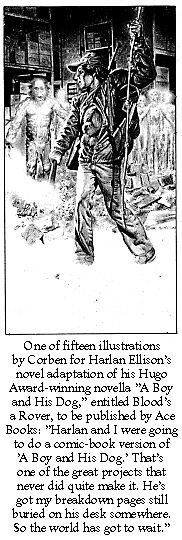
He's got a story called "A Boy and His Dog," which is written as a sequel to "Egg-Sucker," and he's working on another story called "Blood's Rover" - so they are going to be published all together. I did the cover and about fifteen interior illustrations.
Indirectly - I didn't know he lived in Kansas City. He was a partner with Gil Kane, who lives in Connecticut. They had some high ideals about doing graphic novels, whereas he was going to do some of them but needed other artists. He got in touch with me first, and I had to think about working on that project. It was after I had agreed to do the job with Gil Kane and I found out that his partner was Armand. Then they moved to Kansas City (8). The idea of Bloodstar with the star on his head was Gil Kane's. I believe at the time I was at the beginning stages of Bloodstar. Armand was still finishing graduate work in southern California.
How long did Bloodstar take?
That took about nine months, and it was done in black and white. I shipped the stuff to Gil Kane, as he was judging everything to make sure it was okay. Bloodstar is my favourite story so far. I felt it was the most organized of my long stories. I guess I liked it because it was long and I put so much of myself into it. The characters are more realized.
I'll give you a rough breakdown on how it worked. It's based loosely on a story by Robert E. Howard called "Valley of the Worm." Gil Kane was acting as producer, and he also got the writer John Jakes to add quite a bit of additional material. I had the short story and the additional material to integrate together, and in doing so I did a final written version and all the breakdowns and designed the characters and practically wrote it from those two other pieces. My writing was rewritten again by one of the publishers - another writer. My version is the most simple, direct, and clear version of the story. The publisher had his own ideas about adding glory and passion to a story that was underwritten a little bit. They hired my services to do the color work. It's done in my technique but I didn't actually do the color.
What about having a best-seller? Backtrack a moment. How did it end with Ariel?
At the time when it had only been published , the people at Ariel were looking for properties to exploit - so they bought a license. I agreed to do the full-length book, even though only two chapters had been done. A certain number of pages, ninety-six pages, for a certain page rate based on what I have gotten. Later on, I was forced to proceed to the terms of the license no matter what the circumstances were and no matter how much it hurt.
Heavy Metal Magazine and Movie
When did Heavy Metal come into the picture?
It was three years ago, I guess. Indirectly - Heavy Metal was getting material from Metal Hurlant. "Den" was in Metal Hurlant and they wanted to run "Den." They found out from the French people that I lived in Kansas City. When Len Mogel called me, I felt this would be a good way to publicize my work. I thought that was a good idea but I couldn't make a deal; I had to make a deal with these other people and so that's how it was made - very roundabout. Before I appeared in Heavy Metal, my work appeared mainly in underground comics and in Warren magazines. The people who read underground comics are very small in number compared to people who read comics and magazines in general. So I might have had a very small cult following in the underground. The people who read the Warren magazines are a very young readership, and they're also a smaller group. When Heavy Metal started publishing my work I had more reaction in a much shorter time than I had ever had before, from people who suddenly discovered me.
The subject was my idea and it didn't turn out exactly the way I conceived it. But it came out all right. My original concept of Arabian Nights was based more on the images that Maxfield Parrish had done when he had illustrated The Arabian Nights.
How would that have different?
I had planned to make the Arabian world seem much larger than it was - even though it expands over fantastic worlds, it seems to me that it's still contained in a small area.
About the Heavy Metal movie: What value do you think the movie will have to your career?
That's open to conjecture. Everyone is wondering if it's going to be a good movie, or if it's going to draw a lot of attention or not. Hopefully it will draw attention, and if it does, it will make Den more popular and make me more popular. It's good for my work and my future projects.
Why is it that you didn't participate more directly in the movie?
Because I feel in producing a movie, I would become a very small part of a company, whereas here I'm a creator in control. I don't particularly want that to happen. It's not that I have anything against them, it's just that I used to be an animator and I use to work for a large company. Unless you're the person in charge, you really don't have much control over what you do.
What's your result from this film? Beyond having gotten paid for it... didn't they buy the rights?
That's kind of sticky situation there. Armand still has a license to Neverwhere up until September 1981, but that's about the time when the film will be coming out. So he got a lion's share of the up-front money, where I'll be getting all the remaining royalties from it.
So that's certainly a grea bone of contention with you.
That's something I have to live with.
The Richard Corben Interview, Part 2(3), in Heavy Metal #52, June 1981, by Brad Balfour
The Richard Corben Interview, Part 1(3)
The Richard Corben Interview, Part 2(3)
The Richard Corben Interview, Part 3(3)
Richard Corben's Answer for Interviewer

Copyright © 2001 Heart-Attack-Series, Ink!,
Created: Feb. 20, 2001. Modified: January 13, 2019.