
Art © 2001 Heart-Attack-Series, Ink!, SidSid Keränen
The Richard Corben Interview, Part 1(3)
by Brad Balfour
Copyright © 1981 Brad Balfour. Here on this web site by courtesy of the author.
Appeared in Heavy Metal #51, June 1981 (vol. V no. 3), pages 6-11,
the Table of Contents, Copyright © 2001 Heart-Attack-Series, Ink!, SidSid Keränen.
TABLE OF CONTENTS:
The Richard Corben Interview, Part 1(3):
Sex, death, and violence
Exaggeration
Dona Corben
Bloodstar, Den and Kath
Marriage
People's opinion
Symbolism
Hairless in the crotch
Expressing through art
Farm I grew up
Anti-intellectual
Conservative Holocaust
Survival stories
Beth Corben
Corben Empire
The Richard Corben Interview, Part 2(3)
The Richard Corben Interview, Part 3(3)
Richard Corben's Answer for Interviewer
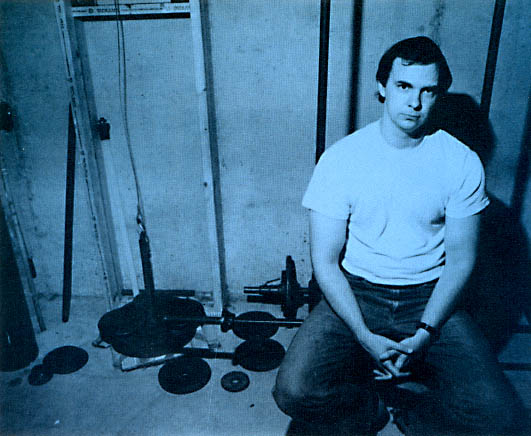
The story is classic: quiet introvert creates wondrous worlds of heroism and powerful fantasy. At least, that's how the facts read on the surface, like something out of Robert E. Howard's history or the biography of that repressed Victorian H.P. Lovecraft. The archetypal myth of the fantasist (exemplified as well in the lives of Aubrey Beardsley, Edgar Allan Poe, and to a lesser degree, Edgar Rice Burroughs) as the unactualized adventurer resides also in Richard Corben's history. But his evolution, from spending as isolated rural childhood to being a numbingly quiet persona as an animator at Calvin Studios in Kansas City, Missouri, contains the kernel of something other than mere repetition of the myths. Maybe it was a matter of the sixties pop-culture explosion or McLuhan's cool media methodology or Andy Warhol's presicient "In the future everybody will be famous for fifteen minutes"; but Richard Corben wasn't meant to wallow in cultdom or rest within the cocoon of comfortable obscurity. Nor is Corben doomed to the niche of the mediocre lightweight (as was E.R. Burroughs). Already a visual superstar internationally - and something of a mystery man by virtue of his silence - Corben stands to step further into the limelight through the animated power of the Heavy Metal movie and its version of Corben's quintessentially heroic tale Den. What has really removed Corben from the vale of mediocrity is a sense of irony. For Corben, crafting the Platonic ideal of hero seemed out of place with the era of his growing up (he was born in 1940) - the post-Hiroshima age. No simple heroic buffoon made of tendon and raw muscle completes the Corben story; the Corben hero's magnificent musculature is born of a love of the grotesque. And Corben'slush, almost blindingly bright color sense seems to originate in psychedelia, through he has steadfastly maintained a nearly drug-free history. Even his own reality of being a husband, family man, and householder in a Kansas City suburb - all of it a cloak of conventionality - seems almost a self-conscious construct, so that he avoids drifting down the chasm of the modern comic-book-creator myth. Now, at forty, he grows forther away from ever being trapped within the person of the mousy man obsessed by his own heroic creations; through a body-building bench press and his own ambition for further creative outlets Corben continues to grow. Even if he dwells within, or rather, somewhere between, his mythos and his realities, then he's now willingly open about it.
- B.B.
Sex, Death, and Violence
BRAD BALFOUR: In all the artists I've met, there's this driven quailty - a strong obsessiveness. I see that in you; what's the source of that obsession?
RICHARD CORBEN: I know I'm obsessed, but I don't know what the roof of it is.
I think it was Jean-Pierre Dionnet who said in Zoom magazine that you were obsessed by sex, death, and violence.
All humanity is.
I guess. But you confront it more directly than a lot of humanity does.
I'd say with average people it's on their mind, but it's hidden way back. They don't want to think about it. I try and come to terms with it in some way that is not quite so horrible as it could be, or in some way that offers resolution, I would say, in a good way.
Why do you think Richard Corben is so blessed with this power to illuminate, or with something that just sets you off from others and makes you seek judgement directly?
Well, maybe God touched me (that's a joke).
Exaggeration
Okay...why do you think people are attracted to your work?
I believe it's the characterizations. I make strong characters and I'm good with figure drawing too. Even though some people think I exaggerate figures and characters both, that's part of my style. They see it first as a realistic drawing. Then when they see the exaggerations they don't like it anymore. That's the point of the drawing, the emphasis that I make.
If you see a person with a long nose, I'll draw him with a slightly longer nose, to emphasize it. If a hero is muscular, I'll make him more muscular. I emphasize things that atract me, or the essence of them. I see things vividly and that's the way I make them. In literature, people may get different images from reading the same story, but in a comic story, it's concrete - that's the way it is.
Why do you think people are attracted to comics?
It's a narrative form, but it's much easier to read than literature. It's simple, so it takes less effort; you're relying on someone else's vision, so you have to do less work to get through it.
That sounds terrible! But the effect of your work is something more than just that: like that of a superrealist painter it's so real, it reveals something else, much more than obvious reality. Is it stuff from the inner psyche - things your're attracted to, maybe? - hidden homosexual or S&M tenderices?
I'm not worried about them. [Mr. Corben's correction, #1]
What do you think of people who say, "This guy Richard Corben has just got to be real perverse!"?
They're full of shit!
Look at the way you exaggerate the male figure. Don't you think there's a sort of subtle homosexual implication in that?
I just emphasize the primary sexual characteristics, and the same thing with the women.
So now people would say, "This guy has to be awfully perverse. He always draws these women with hugh, enormous breasts!" Why do you do that?
To differentiate them from the men, of course.
Are you fascinated by big breasts? I really want to know for sure.
I was, at a time, and now it's just another aspect of a stereotype.
When you were a kid, did you masturbate over big breasts?
I wasn't interested in Playboy or Oui.
Do you think your work is erotic?
Sometimes - maybe sensual.
Would you want to do some work that is purely sensual?
Someday, in the future.
What do you think of somebody masturbating over your work? Do you think that's a possibility?
What they do by themselves is their business.
I bet you've never been asked that question.
No!
Dona Corben
I met your wife. She looks like a nice lady, typical human being. She doesn't have huge breasts. What does that reveal about your psychosexual interests?
I don't know. [Mr. Corben's correction, #2]
So who are you so obsessed with sex?
Because it was repressed in me somehow, I guess.
So what insidious feelings are pent up in there?
I'm a sex maniac.
Oh, yeah? Let's hear about this!
Well, never mind! That's much too involved for now.
It's a curious thing to be a sex maniac as you have described yourself and to have been married for so long.
Obviously I'm talking only on the fantasy level; it's the impetus for the force in my work, but it's all mental, not real. Otherwise it would cause me to be self-pitying.
So, in reality, you don't want to be a sex maniac - or haven't been.
I just want to be a stud! That's one of the sources of my popularity, because I believe that all young men and teenagers feel their goal is to be a stud, and that's sort of visualized for them.
Do you feel you're a teenager at heart?
Yes. Constantly - always youth! I want to be a youth forever and then die! Once you pass your maturity or you've reached the point where you're fully grown, fully formed, and fully a person, you're on a downhill slide. Physically, things seem to fall apart. Even in the thirties things start slowing down; you're not as agile, not as fast, not able to learn as quickly. That's something you can find out only when you reach that point. You can tell people that, but they don't believe it until it happens. And then you find out only by pushing yourself after you're mature.
Do you think your work is adolescent?
There's a level of it that is, I believe.
Bloodstar, Den and Kath
All of your male characters, no matter how old they are in body, have young faces like you.
Yes. The main characters usually are youthful. As my idols change, as I grow older, perhaps the people I draw will start to change too. We're all constantly changing, and this inevitably shows in the work. I'm not exactly sure in what ways, though the new Den probably reflects it.
In some ways the original Den and Kath weren't real, separate characters but were fantasy embodiments of Den/Corben - one seemed the male dream ideal and the other, the desired fantasy ideal. Before, Bloodstar seemed the most realistic of all your characters. Now are the characters more three-dimensional?
When they were created they were pretty artificially done. They were growing in my mind, and it's reflected in the way the stories are going. They are becoming more rounded. I would say at a certain point it was Bloodstar. But I believe Den has dveleoped to where he is more real. I'll give you a clue. Den and Kath split. Whenever in a series a main character falls in love and gets married, they have to kill the woman off or something. In this case, Kath doesn't get killed, she just gets bored.
So Den turns out to be boring.
You see, they have different outlooks on life.
Do you think it reflects a changing Richard Corben?
Probably.
Marriage
I think you've been able to grow because your marriage stabilized your sexual energy so that it could be redirected into work.
If I weren't married, I would probably be a hermit.
I guess finding Donna was in some ways a big help.
The thing about youth is even though they are desperate, there's always hope!
How old were you when you met Donna?
I was teenager, probably about seventeen, I imagine.
Was she your first girl friend?
I would say she was my first serious girl friend. I had gone out on a few dates but nothing ever came of it.
How old were you when you got married?
I got married when I was around twenty-two or twenty-three. That means we've geen married about seventeen years. (That can't be right!) Donna was still a child when we were married - in her personality. The major stress factors in our marriage occurred because of her growing up and becoming adult. Her goals changed drastically. She wanted to be just a servant at first. She has had to push herself out to be a real person. She has a chip on her shoulder from being repressed.
So, as she developed her independece, getting a job outside the house, leading a life separate from yours, did she resent the female images in your work? How has she reacted to them?
I believe there was a preioid when she resented the images in my work. She doesn't now. I think she finally has enough self-confidence that they're not threatening.
Doesn't she worry that you'll run around trying to pick up women that look like that?
No, she knows me well enough to know what I don't really desire these women. It's just the way I draw.
So it's a stable marriage. What accounts for that?
Our determination to make it work, I guess. Even though I am sure there were times neither of us thought we were meant for each other, or we lost our romantic notions, we continued on because we felt we had to for our best sake and for a certain lenght of time as well. And there are other times when it's not bad anyway. I feel a marriage can't last on romantic love, because human personalities are just too volatile. There has to be a sense of responsibility that holds things together.
Do you ever find a conflict between your fantasies and your life's realities?
I did at a certain time, until I met with more people and expanded the number of people I knew. I think women are all alike, no matter what they look like.
People's opinion
What do you think of people accusing you of being sexist?
I don't care. So I am!
You feel you are?
What is their definition of a sexist?
Well, your females seem to be stereotypes of female archetypes, both physically and as characters. They're either beutiful, voputuous sex objects or evil bitches.
That's right, they are. They are, on first appearance. After you read the thing, then the subtleties come through. It works on many levels, broadly, thought it may not be so successful on more esoteric levels.
Symbolism
Well, if a symbolism is there, you don't try to be particularly subtle about it.
When I use a symbol, I do it on purpose and it's not subconscious. The audience dosen't miss it either; it's obvious. If I make a creature with a very long neck, which could be slightly phallic, when I draw it it's very phallic.
What do you find are your favourite symbols?
The circle, the moon, women, and the lion. The circle and moon are both female. The lion is a personal symbol - savage, fierce, usually male, and special to me because my name is Richard, like the Lionhearted, so my animal is suppoused to be the lion.
Do you think you're conscious of creating cretain sex symbols?
No, because I usually work in a medium with implied continuity, wherein one image is not always before the viewer.
What do you think of certain sex symbols?
They're women and they're people, but when they're up on a poster, that has no meaning to me.
Do you ever regret you don't have more contact with women like your characters?
No, because once you get to know them, they can be just as dumb as ugly ones. I think women who condemn my work because it's sexist haven't even read it. They just look at the pictures adn say, "That's sexist." Women who proclaim that men and women are the same are stupid. There is a basic difference between men and women. There's no way you can get around it; there never will be! Creating a society without the difference is completely artificial and is doomed.
Hairless in the Crotch
Are your women strictly sex kittens and your men just big, macho heroes? Or do you feel they are more?
They are to some people, and they are on certain levels. Character is just one small aspect of doing the art. There are many aspects: composition, direction, textures, proportions, and emphasizing characteristics are probably more important to me than to other cartoonists. And, if you see large breasts, you can tell from a great distance if it's a man or a woman.
Do you think that's a problem nowadays?
No, but it's the basis of an emphasis! Like I said earlier, if there is a difference in characters, then I am going to emphasize that difference to the point of absurdity.
Why are some of your women hairless in the crotch?
Because I like drawing the forms, and hair destroys form. A form without hair is simpler and slightly bizarre, too.
What do you like about the grotesque?
I believe that is something basic in humans. They like anything different that holds their interest. The more different and bizarre, the more interesting is.
But look how much people like to conform to society!
They don't wna to be weird themselves: they want to look at other people who are weird.
Do you ever want to be endowed as your characters are or be somehow like them?
No, beause it's in the role of a drawing, and there is no balance to a drawing, but there is balance to people. For a real person to be like a character in a drawing would be monstrous: not just in the physique, but in the face or anything if it was actually rendered into flesh and bone. It's not real - at least the way I draw it. When I emphasize certain characteristics it's not becase I'm following a style or in reaction to a style, it's because I feel it's an emphasis for this particular detail. My idea is to have the fantasy completely realized so that it becomes realistic or so that it would seem real.
By realizing fantasies as completely as you can in this way, you deal with them. You don't need to seek every big-breasted women in the world. You can, like other redblooded American males, talk of "hot chicks" but not expect to fuck them.
I know that women are more than just to fuck. That's what they rebel against, being objects, and that's why I feel that in the long run, you're just kidding yourself if you use them only that way.
That word reminds me of an attack an underground cartoonist made against me once. He claimed he was making an attack against me and any other cartoonist who worked in horror and fantasy and science fiction. He claimed funny comics are cathartic; I claimed horror comics and fantasy comics are cathartic.

The Richard Corben Interview, Part 1(3), in Heavy Metal #51, June 1981, by Brad Balfour (CONT...)

Copyright © 2001 Heart-Attack-Series, Ink!,
Created: Jan. 22, 2001. Modified: January 13, 2019.